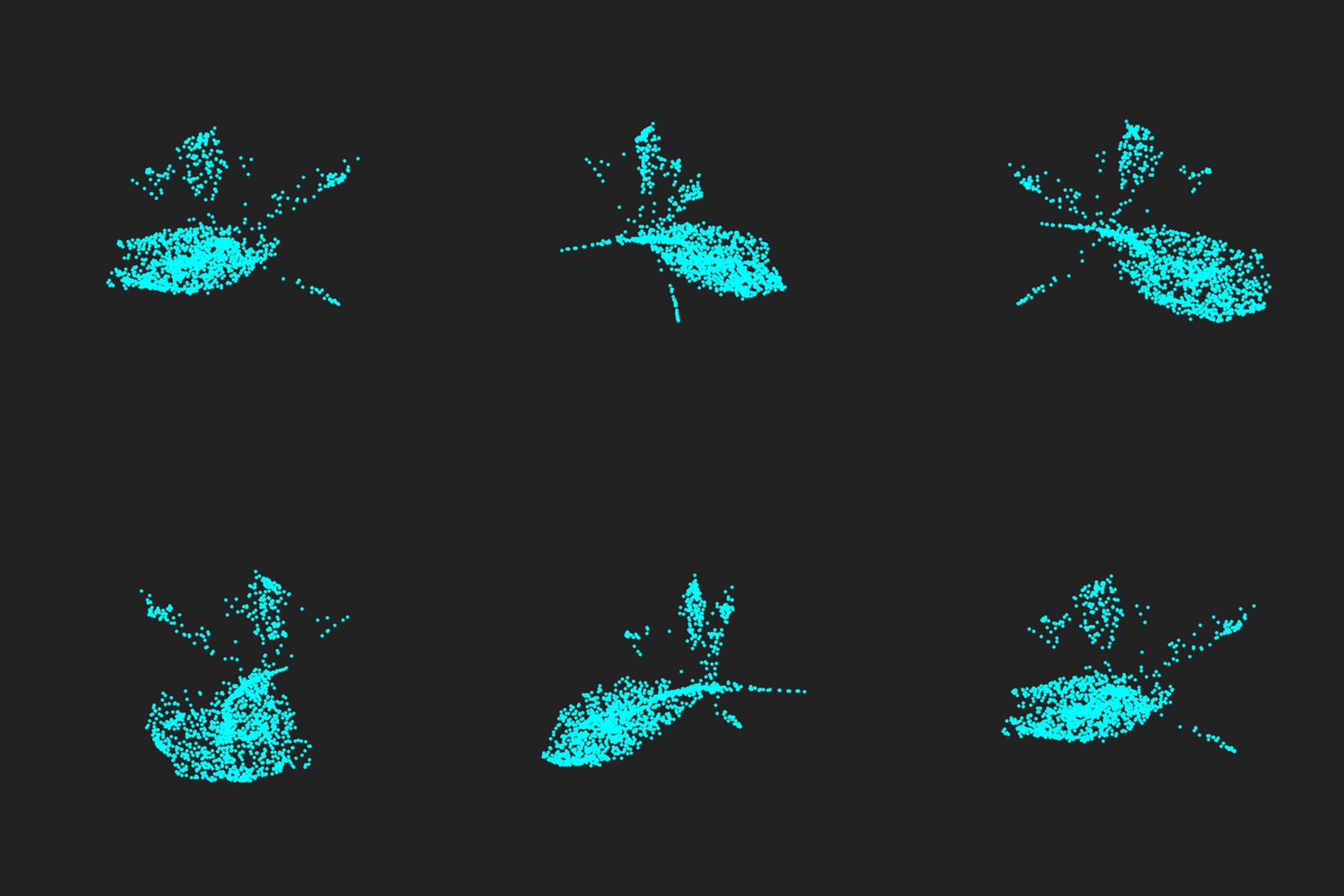
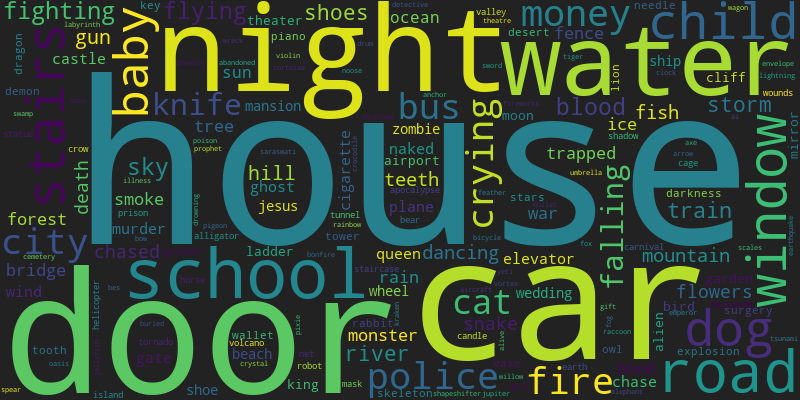
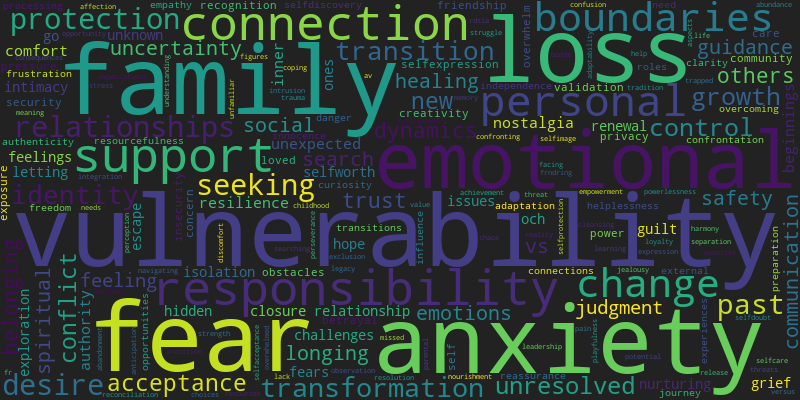
These constellations point to a shared psychological climate: people are trying to stay open without getting hurt, change without losing themselves, and belong without betraying what is true for them. A lot of the dream material circles around trust, identity, pressure, grief, and unfinished emotional business. On the personal level, this often means the psyche is working on safety, separation, renewal, and repair. On the cultural level, it suggests a world where people are overstimulated, emotionally exposed, and hungry for real connection, but unsure where they can safely place their trust.
The Wound of Exposure
This constellation gathers vulnerability, isolation, support-seeking, privacy, empathy, boundaries, betrayal, trust, judgment, insecurity, family and power dynamics. Psychologically, it looks like a struggle between the need to be seen and the fear of what will happen if one is truly seen. These dreams often appear when a person is carrying relational stress: mixed signals, shaky trust, fear of humiliation, or a long history of having to read the room carefully before speaking honestly.
The deeper issue here is not just exposure. It is the question: where is it safe for me to exist as I am? That is why empathy and betrayal sit so close together. The psyche is testing whether closeness leads to care or to harm.
In society, this constellation fits a culture of constant visibility. People are more watched, more compared, and more psychologically porous than before. Privacy becomes emotional, not just digital. And many people are trying to build boundaries after learning too late what happens when they do not have them.
Useful questions: Where am I hiding because I need protection, and where am I hiding out of habit? Who earns access to my inner life, and who simply takes it? What kind of support do I actually need, rather than wish someone would guess?
Practical direction: strengthen one boundary, not ten. Say one honest thing to one trustworthy person. Notice where shame is distorting your self-image. And pay attention to old family or authority patterns that may still shape how you handle trust now.
Becoming Someone New
This constellation centers on transformation, healing, creativity, self-expression, self-discovery, growth, letting go, renewal, cleansing, independence, and new beginnings, with fear and anticipation woven through it. This is the psyche in a transitional state. Something old is loosening. Something more alive is trying to emerge. But change brings anxiety because every real transformation includes loss: loss of certainty, loss of familiar roles, loss of the version of self that once kept things stable.
Creativity matters here because the psyche does not only want relief. It wants expression. Healing is not just damage repair. It is often the recovery of movement, voice, and permission.
Culturally, this reflects a broader hunger for reinvention. Many people feel they cannot continue under old scripts, but they do not yet trust what comes next. So dreams become rehearsal space for identity change before waking life can hold it.
Useful questions: What am I outgrowing? What am I trying to force before it is ready? What part of me wants freedom, and what part is scared of what freedom will ask from me?
Practical direction: treat transformation as a sequence, not a leap. Let go of one role, one object, one obligation, or one story that no longer fits. Make room for a form of expression that feels slightly risky but real. And remember that anticipation and fear often rise together when growth is genuine.
The Ache of Belonging
This constellation brings together identity, acceptance, loss, change, belonging, grief, closure, helplessness, and unresolved emotion. These dreams often appear when a person is trying to answer a painful question: who am I now that something has ended, changed, or been taken away? Grief is not only about people. It can be about versions of self, communities, futures, places, bodies, beliefs, or innocence.
The wish for closure here is understandable, but the psyche often resists neat endings. Some feelings need to be metabolized before they can be closed. Helplessness enters when the dreamer senses that acceptance cannot be forced by will alone.
Socially, this constellation fits a time of rapid identity strain. People are moving across roles, countries, communities, and ideologies. Many are grieving old sources of belonging while still trying to appear functional. That creates a silent loneliness: being socially connected while existentially unmoored.
Useful questions: What am I still grieving that I have tried to label as “already handled”? Where do I confuse acceptance with resignation? What kind of belonging actually fits who I am becoming?
Practical direction: name the loss plainly. Stop demanding closure on a schedule. Let grief tell you what mattered. And notice whether your current life has enough spaces where your identity can be held without performance.
Holding the Line Under Pressure
This constellation links protection, loss of control, transition, anxiety, responsibility, intrusion, fear, overwhelm, uncertainty, family, support, leadership, authority, and pressure. These dreams often arise in people who feel they must hold things together while their inner system is already overloaded. The core tension is between duty and capacity. There is often a fear that if vigilance drops, something important will fall apart.
Protection and intrusion sitting together suggests weak psychological borders under stress. The dreamer may feel invaded by demands, expectations, or other people’s emotional needs. Leadership here may not only mean formal authority. It can mean being the one who absorbs uncertainty for everyone else.
In larger cultural terms, this reflects a world of chronic strain. Many people are carrying family pressure, economic pressure, social pressure, and information pressure at once. Authority itself has become unstable: people may crave guidance while distrusting those who claim to provide it.
Useful questions: What am I responsible for, and what have I merely become accustomed to carrying? Where does support exist in theory but not in practice? What am I protecting, and at what cost?
Practical direction: separate true duty from overfunctioning. Build one protection ritual around time, space, or communication. Ask for specific help instead of vague reassurance. And notice whether your anxiety rises most when control is actually threatened, or when uncertainty simply becomes visible.
Longing for What Felt Real
Nostalgia and connection form a small but telling constellation. These dreams are not just sentimental. They often point to a part of the psyche that is searching for emotional truth through memory. Nostalgia can be a longing for a person, a place, a period of life, or simply a state in which connection felt more direct and less fractured.
Sometimes such dreams are restorative. Sometimes they reveal that the present feels emotionally thinned out. The dream uses the past not to trap the person there, but to remind them what kinds of connection once felt meaningful.
Socially, this fits a culture that is hyperconnected but often undernourished. Many people are surrounded by contact but starved of depth. So the psyche reaches backward to remember what warmth, slowness, and presence felt like.
Useful questions: What exactly am I missing: the person, the time, or the feeling I had in that period? Is nostalgia helping me remember a value, or keeping me from grieving change?
Practical direction: translate nostalgia into present action. Recreate one quality from the past in current life: slowness, play, intimacy, place, ritual, or attention.
Fear of Losing the Bond
This constellation brings together fear of loss and relationship anxiety. It is compact, but psychologically strong. These dreams often show the attachment system on alert. They can emerge when love matters deeply, when trust is still forming, or when old abandonment patterns get activated by present uncertainty.
The psyche here is not only afraid of losing a person. It may be afraid of losing emotional ground, status in the relationship, or the sense of being chosen. That is why these dreams can feel disproportionate. They are often plugged into older emotional memory, not only current reality.
On a broader level, this reflects fragile attachment in an unstable time. When life feels unpredictable, relationships carry even more emotional weight. People may ask them to provide total security, which no relationship can fully do.
Useful questions: What am I actually afraid of losing? What evidence belongs to the present, and what belongs to older hurt? What would help me feel more secure without asking for impossible guarantees?
Practical direction: name the fear before it turns into protest, withdrawal, or suspicion. Ask for clarity, not mind-reading. And look closely at whether your anxiety is warning you about something real, or repeating an old alarm.
The Inner Tribunal
Guilt and judgment form a severe but important constellation. These dreams often point to a harsh internal authority: the part of the psyche that evaluates, condemns, compares, and keeps score. Sometimes this reflects conscience. But often it reflects an overdeveloped inner critic shaped by family, culture, religion, or repeated shame experiences.
The key question is whether guilt here is useful. Healthy guilt helps repair harm. Toxic guilt keeps the self in a permanent state of accusation. Judgment then spreads outward too: people who are harsh with themselves often live in a world that also feels harsh and watchful.
Culturally, this fits a punitive social environment. People are under constant moral and social review, including by themselves. The psyche absorbs this climate and turns it inward.
Useful questions: What am I actually responsible for? What standard am I trying to satisfy, and whose voice does it belong to? Is this guilt asking for repair, or for self-punishment?
Practical direction: distinguish accountability from self-attack. Make one repair where repair is needed. And where it is not, practice refusing the trial altogether.
Ghosts of Unfinished Love
This constellation centers on past relationships and unresolved feelings. Dreams like these usually do not mean the dreamer simply wants an ex back. More often, the psyche is revisiting unfinished emotional material: longing, anger, regret, tenderness, betrayal, identity fragments, or questions that were never fully lived through.
Former partners become symbols because they carry concentrated emotional meaning. They can represent not just the person, but a younger self, a missed path, an unmet need, or a wound still active in present relationships.
Socially, this reflects how modern relationships often end without real processing. Contact may stop, but psychic attachment does not end on command. And because people move fast, old bonds may remain unintegrated beneath new ones.
Useful questions: What feeling returns when this person appears in the dream? What did that relationship teach me about my needs, patterns, and thresholds? What remains unfinished in me, even if the relationship itself is long over?
Practical direction: do not read these dreams too literally. Track the emotion, not just the character. Write down what was never said. And notice whether the past is visiting because it wants reunion, or because it wants understanding.
Final Reflections
Taken together, these constellations suggest a shared human task: learning how to remain open without collapsing, honest without self-betrayal, and connected without losing inner ground. Some constellations sit close to each other for a reason. Fear of loss can feed judgment. Unresolved relationships can shape present trust. Grief can sit underneath transformation. Pressure can make vulnerability feel dangerous.
The invitation for Seers is simple: do not treat these dream patterns as random. Ask which constellation feels most alive in your life right now, which one feels older, and which one may be waiting in the background. Notice which themes cluster tightly in you and which feel distant. That distance matters. It may show where you are defended, where you are growing, or where something still needs time.
The dreams do not ask for perfect interpretation. They ask for honest attention. Stay with the feeling, the pattern, and the question beneath the image. That is often where the real message begins.